Best Surfing Camps for Adults: A Comprehensive Operational and Analytical Guide
The global landscape of adult recreational travel has shifted significantly toward skill acquisition and experiential immersion. Among these pursuits, immersive surf coaching programs have emerged as a prominent sector. This development reflects a broader cultural pivot toward structured, athletic adult education. Adult learners increasingly seek environments that balance physical challenge with technical instruction, moving away from traditional leisure-oriented vacations. This analytical piece examines the operational, pedagogical, and structural variables that define high-quality surf coaching infrastructure globally.
Evaluating these environments requires a framework that extends beyond standard hospitality metrics. The adult learning process for an open-ocean sport like surfing involves complex biomechanical, psychological, and oceanographic factors. Unlike childhood skill acquisition, which relies heavily on intuitive mimicry, adult learning requires explicit, systematic breakdown of movement patterns. Furthermore, adults must manage distinct risk profiles, physical limitations, and cognitive barriers, such as a heightened awareness of personal safety. Consequently, the efficacy of a surf program depends on its capacity to address these specific adult learner dynamics.
This analysis deconstructs the market, methodologies, and operational realities of dedicated adult surf coaching. By examining instructional design, oceanographic variability, risk mitigation, and financial structures, this guide establishes an objective standard for evaluation. The objective is to provide a rigorous, definitive reference for identifying and assessing environments capable of facilitating genuine, long-term athletic progression in adult surfers.
Understanding “best surfing camps for adults”
The phrase “best surfing camps for adults” is frequently deployed within the travel industry as a generic marketing tag. This commercial usage often obscures the deep operational and pedagogical differences between individual operations. For a surf program to genuinely serve adults, it must move beyond basic equipment rentals and group lessons led by seasonal instructors. True efficacy in adult surf coaching requires a structured environment tailored to the cognitive and physical realities of mature learners.
A common oversimplification is the assumption that a standard surf school can be converted into an adult camp simply by upgrading the lodging and adding social amenities. While comfort and hospitality matter to adult travelers, these elements do not improve wave-catching capability or technical execution. High-quality programs are distinguished by their instructional architecture, which includes video analysis, land-based simulation, and tailored oceanography modules. Without these specific analytical tools, adult learners often struggle to overcome established movement habits or manage the complex environment of an active surf lineup.
Furthermore, evaluating these camps requires understanding the tension between immediate vacation satisfaction and long-term skill development. Programs focused entirely on guest amusement often rely on instructors pushing students into waves. This method provides the immediate thrill of riding a surfboard but bypasses the critical skills of wave reading, positioning, and paddle mechanics. Conversely, a technically rigorous program focuses on independence, teaching students to read ocean swells and manage their own placement in the water. True quality in this sector is defined by how well a camp prepares an adult to surf safely and confidently without supervision.
The Evolution of Adult Surf Pedagogy
Historically, surf skills were acquired through informal, regional apprenticeship models. Young surfers spent years watching peers, experimenting with equipment, and deciphering ocean dynamics through trial and error. This unstructured approach relied on high volumes of time in the water and the neuroplasticity of youth. The surf industry focused almost exclusively on youth development, viewing surfing as a lifestyle choice rather than a sport open to later-stage athletic entry.
As the demographics of global tourism shifted in the late twentieth and early twenty-first centuries, demand from adult learners grew. This shift forced an evolution in coaching methods. The informal “watch and learn” approach proved ineffective for adults, who typically have limited time and require analytical explanations of movement. Early attempts to meet this demand often resulted in standard surf schools branding themselves as adult camps without modifying their teaching methods. These programs generally used high-volume soft-top boards and large group ratios, which failed to foster meaningful skill development beyond standing up in white water.
Modern Methodological Shifts
Over the past two decades, professional surf coaching has adopted methodologies from other technical sports, such as gymnastics, skiing, and Olympic weightlifting. Progressive camps began integrating video review, skateboard or surf-skate simulations, and land-based breath-hold training into their core curricula. This formalization led to the creation of international coaching certifications, which established baseline standards for safety and instructional design. Today, top-tier operations are characterized by a systematic approach that treats surfing as an analytical discipline rather than an intuitive art form.
Cognitive and Biomechanical Learning Frameworks
Adult motor skill acquisition operates under distinct neurological constraints compared to childhood learning. Adults possess fully developed prefrontal cortexes, which favor analytical breakdown over intuitive replication. While a child might mirror an instructor’s movement without intellectualizing it, an adult generally needs to understand the biomechanical rationale behind a posture. This reality requires coaching frameworks that translate complex, fluid ocean movements into discrete, repeatable steps.
Proprioceptive Awareness in Liquid Environments
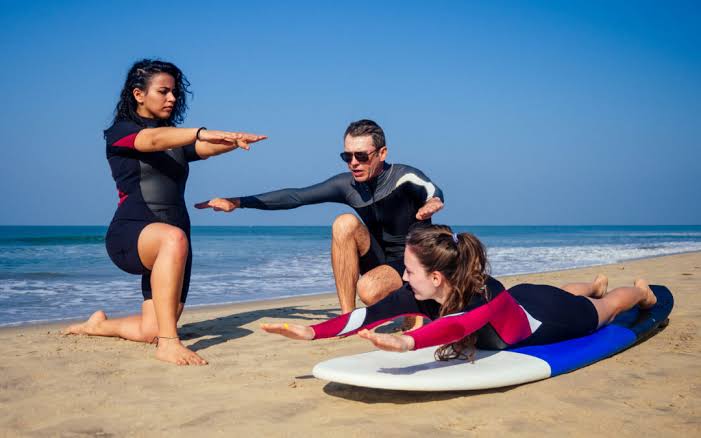
Surfing requires high levels of proprioceptive awareness—the body’s ability to perceive its position and movement in space—on an unstable, shifting surface. For adults, developing this awareness is complicated by existing movement patterns established through sedentary work or other sports. A high-quality adult surf program must address these pre-existing habits by using land-based drills to isolate specific movements before attempting them in the ocean.
The Three Stages of Motor Learning
To systematically guide adult progression, advanced programs structure their curricula around established motor learning phases:
-
The Cognitive Stage: The learner intellectualizes the movement pattern, focusing on the mechanics of the pop-up or paddle stroke. Visual aids and technical lectures are vital during this phase.
-
The Associative Stage: The learner transitions from understanding the movement to refining it based on real-time feedback. Errors are detected and corrected through video review and in-water coaching.
-
The Autonomous Stage: The movement becomes automatic, allowing the surfer to focus on ocean dynamics rather than mechanics. Reaching this stage requires significant time, but structured camps accelerate the transition by preventing the formation of bad habits.
Limitations of Accelerated Frameworks
While structured coaching accelerates learning, physical limits remain. Neuroplasticity decreases with age, meaning that deeply ingrained movement errors require consistent, long-term effort to fix. Additionally, short-term intensive camps cannot fully replicate the years of ocean exposure needed to read complex swell patterns instinctively. High-quality programs acknowledge these limitations, focusing on teaching students self-correction strategies rather than promising mastery in a single week.
Categorization of Adult Surf Programs
The market for adult surf coaching is divided into several operational models, each designed for different budgets, goals, and learning styles. Understanding these structural differences is essential for matching an adult learner with an appropriate program.
Destination Coaching Enclaves
These operations function as dedicated training centers, often located in regions with highly consistent wave patterns, such as Central America, Indonesia, or Southwest Europe. They feature structured, week-long packages that integrate lodging, coaching, video analysis, and meals. The primary advantage is total immersion, allowing guests to focus entirely on training. The trade-off is often cost, as these all-inclusive environments require significant financial investment.
Mobile Guiding and Boat Charters
Designed primarily for intermediate to advanced adult surfers, these programs utilize mobile vans or boats to access remote or uncrowded surf breaks. The focus shifts from basic mechanics to wave selection, lineup strategy, and adapting to diverse reef and point break setups. This model offers unmatched access to high-quality waves but lacks the controlled environment and land-based video facilities of stationary camps.
Resort-Integrated Surf Academies
These programs operate within broader luxury resorts, catering to travelers who want high-quality coaching alongside premium lifestyle amenities. While they offer excellent comfort, spa facilities, and diverse dining, the coaching can sometimes be less rigorous than at dedicated training enclaves. These academies are well-suited for couples or families with mixed interests, where one partner surfs while the other utilizes resort facilities.
Comparative Operational Matrix
Analytical Selection Logic
Choosing among these categories requires a realistic assessment of one’s current fitness, surfing ability, and learning objectives. A novice surfer will see minimal benefit from a mobile boat charter in Indonesia, where powerful reef breaks can pose safety hazards. Conversely, an experienced intermediate surfer seeking to refine their rail transitions will find a resort-integrated program too basic. Aligning your specific technical needs with a camp’s operational structure is critical for maximizing development.
Real-World Selection and Operational Scenarios
To illustrate how these factors interact, we can analyze several distinct archetypes of adult surf camp applicants. These scenarios highlight the decision points, risks, and expected outcomes across different operational structures.
Scenario A: The Career Professional with High Fitness but Low Ocean Familiarity
This archetype involves an adult who maintains excellent physical conditioning through gym training or running but has spent minimal time in the open ocean.
-
Analysis: This individual possesses the strength needed for paddling but lacks the ability to read wave energy, often leading to timing errors.
-
Optimal Choice: A destination training enclave focused heavily on oceanography lectures, wave-reading drills, and video analysis.
-
Risk Factors: Overconfidence in physical strength can lead to entering challenging conditions without understanding the underlying current mechanics.
-
Second-Order Effects: Rapid initial development of paddling power, followed by frustration if wave-catching success remains low due to poor positioning.
Scenario B: The Mature Intermediate Surfer Addressing Long-Term Movement Errors
This scenario involves an adult who has surfed recreationally for several years but has hit a plateau, often due to a flawed pop-up or stiff stance.
-
Analysis: The main challenge is breaking down deeply ingrained movement habits that limit turning capacity or speed generation.
-
Optimal Choice: An intensive coaching clinic that uses land-based surf-skate training and daily split-screen video comparisons with professional surfers.
-
Risk Factors: Regression in performance during the first few days as old habits are broken down before new ones are established.
-
Second-Order Effects: Increased mental fatigue as the surfer moves from automatic execution back to conscious, analytical movement.
Scenario C: The Active Older Adult Seeking Longevity and Injury Mitigation
This archetype focuses on an older individual who wants to surf safely while managing joint stiffness, lower back issues, or reduced agility.
-
Analysis: The program must prioritize joint longevity, custom board selection, and smooth transitions rather than explosive maneuvers.
-
Optimal Choice: A premium resort academy or dedicated enclave that offers small group ratios, custom high-volume epoxy or fiberglass boards, and daily physical therapy or yoga support.
-
Risk Factors: Shoulder strain from improper paddle biomechanics or knee injuries from a tight, forced pop-up stance.
-
Second-Order Effects: Improved physical durability and the development of a smoother, more efficient surfing style that requires less raw power.
Financial Dynamics and Resource Allocation
Enrolling in a high-quality adult surf program requires a clear understanding of both direct costs and long-term value. Adult learners must evaluate these programs based on instructional quality rather than just hospitality amenities.
Direct vs. Indirect Cost Structures
The total cost of a surf coaching program includes several components beyond the base package price. Travelers must account for flight logistics, specialized travel insurance, board bag fees, and tipping for local guides and hospitality staff. Additionally, high-end programs often charge extra for raw video footage, individual photos, or private coaching upgrades. These additions can increase the total cost of a trip by twenty to thirty percent.
The Cost of Cheap Instruction
Choosing a program based solely on a low price often results in hidden operational trade-offs. Cheap camps typically use high coach-to-student ratios, meaning less individual attention and feedback. They may also employ less experienced instructors who lack advanced safety certifications or technical training. Furthermore, cheaper operations often use older, generic equipment that may not suit an individual’s specific height, weight, and skill level, slowing overall development.
Range-Based Financial Investment Framework
Technical Tools and Diagnostic Support Systems
Modern surf coaching relies on technical tools to bridge the gap between what a surfer feels and what is actually happening on the wave. These diagnostic systems help adult learners see and correct their alignment, posture, and timing errors.
The Role of High-Frame-Rate Video Analysis
Video review is a fundamental tool for adult technical development. Because surfing happens quickly in a dynamic environment, surfers often have an inaccurate sense of their own body positioning. Watching high-frame-rate video allows students to analyze their mechanics frame by frame. When coaches use split-screen comparisons alongside footage of advanced surfers, students can clearly see errors in weight distribution, eye gaze, and rail engagement.
Surf-Skate and Land Simulation Tools
Carving skateboards, specifically designed surf-skates with loose front trucks, are highly effective for building muscle memory on land. In the ocean, a beginner or intermediate surfer might spend only a few minutes actually riding waves during a multi-hour session. On land, a surf-skate allows for endless repetitions of turns, compressions, and extensions on a stable surface. This repetition helps automate correct upper-body rotation and arm placement, making those movements easier to replicate in the ocean.
Constraints of Technical Training Tools
While these diagnostic tools are highly beneficial, they have operational limits. Video analysis is only as useful as the coach’s ability to explain the mechanics and provide actionable corrections. Excessive technical feedback can also lead to “analysis paralysis,” where a surfer becomes overly focused on mechanics and struggles to adapt to changing ocean conditions. Land-based simulations can mimic turning mechanics but cannot recreate the paddling endurance, timing, and wave-reading skills required in the water.
Risk Landscape and Safety Taxonomy
Surfing carries inherent physical risks that require careful management, particularly for adult learners who may have longer recovery times than younger athletes. High-quality camps prioritize risk mitigation through clear safety protocols, staff certifications, and thorough oceanography education.
Environmental and Oceanographic Hazards
The open ocean presents a constantly changing set of risks, including rip currents, shallow rock or coral reefs, shifting sandbars, and large waves. A professional adult surf camp must manage these hazards by selecting surf breaks that match the group’s skill level. Instructors should conduct thorough spot briefings before every session, explaining current behavior, entry and exit channels, and specific bottom contours. Understanding these factors helps minimize anxiety and reduces the risk of panic in challenging conditions.
Equipment-Related Injuries
Injuries in surfing frequently result from impacts with a surfer’s own equipment or boards ridden by others in a crowded lineup. Sharp fins, hard fiberglass rails, and tensioned leashes can cause lacerations, bruising, or concussions if not managed carefully. To mitigate these risks, high-quality adult camps use specific safety protocols:
-
Using soft-top or composite boards with flexible safety fins for true novice surfers.
-
Teaching proper board management, such as never placing the surfboard between yourself and an incoming wave.
-
Enforcing safe distance rules within the water to prevent collisions between group members.
-
Instructing students on how to fall safely—protecting the head with the arms and flat-body positioning to avoid hitting the bottom.
Long-Term Skill Adaptation and Maintenance
A common challenge for adult surf camp participants is maintaining the progress made during an intensive week of coaching once they return home. Sustaining development requires a structured approach to practice, physical conditioning, and skill review outside of camp environments.
The Post-Camp Performance Drop
During a high-quality surf camp, students benefit from optimized conditions, expert board selection, and immediate coaching feedback. Back in their home environments, surfers often face colder water, less consistent waves, crowded lineups, and an absence of regular feedback. This transition can lead to a drop in performance and motivation if the surfer lacks a clear strategy for independent practice.
Building an Independent Practice Plan
To prevent regression, adult surfers should design a structured training routine based on their camp evaluations. This plan should combine physical conditioning with targeted dry-land practice to keep relevant muscle groups active:
-
Paddling Endurance: Regular swimming, paddling a surfboard in flat water, or upper-body strength training to maintain paddle fitness.
-
Mobility Work: Targeted flexibility exercises for the hips, thoracic spine, and shoulders to support a clean, fast pop-up.
-
Land-Based Drills: Continued use of surf-skate training to reinforce correct turning postures and weight transitions.
-
Mental Visualization: Reviewing personal surf footage from camp to keep technical benchmarks fresh in mind.
Evaluation Frameworks and Progression Metrics
Measuring athletic development in a fluid sport like surfing requires moving beyond subjective assessments like “feeling better on the board.” High-efficacy programs use objective evaluation frameworks to track progress across paddling efficiency, wave reading, and riding mechanics.
Leading vs. Lagging Performance Indicators
To properly evaluate progression, coaches and surfers must distinguish between leading and lagging indicators of skill development:
-
Leading Indicators (Input-focused): Paddle cadence, chest elevation during paddling, positioning relative to the peak, and early eye gaze toward the shoulder of the wave. These metrics reflect a surfer’s technical setup and decision-making.
-
Lagging Indicators (Output-focused): Total ride time, wave count per session, and the execution of a specific turn. These outcomes depend heavily on the quality of the leading inputs.
Qualitative and Quantitative Assessment Metrics
A comprehensive tracking system combines quantitative data with qualitative video analysis. For example, a surfer might track their wave-catching ratio—the number of waves successfully ridden divided by the number paddled for—alongside a qualitative review of their pop-up speed. By documenting these metrics over time, adult surfers can identify specific plateaus and adjust their training focus accordingly.
Deconstruction of Common Misconceptions
The surf travel market contains numerous persistent myths that can lead adult learners to select inappropriate programs or form unrealistic expectations about their progression.
Myth 1: True Surfing Requires Fiberglass Shortboards
Many adult learners assume that moving to a small, fiberglass shortboard is the ultimate marker of surfing progress. This belief is often encouraged by media representations of high-performance surfing. In reality, shortboards require exceptional paddle strength, precise positioning, and explosive pop-ups—demands that can hinder development for older or less experienced adults. High-volume funboards, mid-lengths, or longboards offer more surface area and stability, allowing adults to maximize wave count and focus on refining turning mechanics.
Myth 2: Fitness Alone Guarantees Surfing Success
It is common for cross-fitters, triathletes, or ocean swimmers to assume their high fitness levels will translate directly to quick success in the surf. While aerobic conditioning and upper-body strength are highly beneficial, they cannot replace the technical skills of wave reading and micro-positioning. An experienced surfer with average fitness will consistently outperform a highly conditioned athlete who lacks an understanding of ocean swell dynamics.
Myth 3: Warm Water and Sunny Weather Equals Better Learning
Many travelers prioritize tropical destinations, assuming that warm water and sunny weather provide the best environment for learning. While warm-water locations are comfortable, they often feature heavy crowds, intense sun exposure, and shallow, unforgiving coral reefs. Conversely, cooler-water destinations like Portugal, the United Kingdom, or Northern California often offer highly structured academies, less crowded lineups, and consistent beach breaks that are excellent for foundational skill development.
Structural and Environmental Considerations
A successful adult surf experience relies on aligning personal capabilities with environmental realities. Wave mechanics vary dramatically around the world, and each type of surf break offers distinct advantages and drawbacks for the adult learning process.
Types of Surf Breaks and Their Implications
The underlying geology of a surf spot dictates the shape, speed, and predictability of the waves:
-
Beach Breaks (Sand Bottoms): Shifting sandbars create waves that change constantly with the tide. They offer a softer landing surface but require quick adaptation due to less predictable peaks.
-
Point Breaks (Rocky Coastlines): Sells wrap around a headland, creating long, predictable waves with clear entry channels. They are excellent for technical practice but can feature competitive lineups.
-
Reef Breaks (Coral or Rock Bottoms): Swells break over a fixed underwater structure, offering highly consistent wave shapes and clear positioning markers. The trade-off is the hazard of a hard, shallow bottom, which requires careful management.
Selecting an Environment for Progression
Adult surfers must match their technical goals with the appropriate break type. Beginners benefit from the safer landings of a beach break or the mellow rolling waves of a longboard point break. Intermediates looking to refine specific maneuvers often progress faster at predictable reef or point breaks, where the consistency of the wave allows them to focus entirely on body mechanics. Assessing these environmental factors alongside coaching quality ensures a safer, more productive training experience.