Guide to Top Wave Riding Retreats America: Professional Surf Travel Analysis
The evolution of surf travel from unstructured backpacking to highly specialized athletic tourism has altered how individuals approach wave acquisition. Across the coastlines of North America, Hawaii, and connected territories, a diverse network of surf camps, dedicated lodges, and high-performance training centers has emerged. These operations serve an audience that increasingly values precise instructional design, coastal access, and technical feedback over simple coastal leisure. However, the lack of a centralized grading system across these destinations creates a confusing marketplace for consumer research. Selecting an elite training environment requires a methodical evaluation of localized hydrodynamics, coaching credentials, and resource allocation models.
Developing authentic skill in a marine environment demands a deep understanding of fluid mechanics, coastal geography, and physical conditioning. Many travelers select coastal accommodations based primarily on hospitality metrics, such as lodging aesthetics or local culinary reputations. While these factors influence overall comfort, they do not improve paddling endurance, wave reading, or line navigation. Substandard surf programs frequently hide poor coaching methodologies behind high-end lifestyle marketing, leading to frustration when guests fail to achieve independent ocean confidence. A successful trip relies on matching personal physical readiness with an operation’s underlying instructional framework.
Analyzing the top wave riding retreats america requires looking past promotional material to examine the actual mechanics of surf education. Elite operations treat wave riding as a rigorous sport, applying concepts from sports science, video analysis, and oceanography. These facilities manage the natural risks of the ocean through strict safety protocols, low student-to-instructor ratios, and structured progression plans. By understanding the operational differences between tourist-oriented resorts and dedicated training academies, travelers can make informed investments in their athletic development. This comprehensive guide serves as a definitive reference for analyzing, planning, and executing high-level surf travel within the region.
Understanding “top wave riding retreats america”
Deconstructing the Core Definition
Evaluating the top wave riding retreats america requires a clear definition that separates serious training facilities from standard beachside hotels. In this professional analysis, a wave riding retreat is defined as a structured, multi-day instructional program designed to improve a surfer’s technical skill and ocean literacy. These operations must provide consistent coaching, appropriate equipment fleets, and direct access to suitable surf zones.
Programs that merely offer board rentals or occasional surf lessons do not meet the criteria of an elite training retreat. True retreats combine housing with a planned educational program that addresses the physical and cognitive aspects of surfing.
Addressing Common Oversimplifications
A frequent error among consumer researchers is assuming that all highly rated coastal resorts provide excellent surf instruction. Many premium locations maintain excellent online reviews because of their high-end amenities, spa services, and customer relations. However, these hospitality metrics have no connection to an operation’s ability to analyze movement mechanics or teach water safety.
A program may provide luxurious accommodations while relying on uncertified guides who use outdated, unstructured teaching methods in the water. Travelers must separate lifestyle perks from technical training quality when researching these destinations.
Another common misunderstanding is the belief that geographic proximity to world-class waves guarantees an effective learning environment. Elite surf breaks, such as those found on the North Shore of Oahu or the reefs of Southern California, are often unsuited for beginner and intermediate surfers due to heavy crowds, powerful currents, and shallow seafloors.
The top wave riding retreats america carefully match a student’s current physical capabilities with appropriate wave types. Operations that take developing surfers into advanced lineups without proper preparation create safety hazards and slow down skill acquisition.
Geographic Evolution and Historical Context of American Surf Travel
The Origins of Domestic Surf Travel
The roots of structured surf travel in the United States trace back to the early twentieth century, when Hawaiian watermen introduced wave riding to the Atlantic and Pacific coasts. Early training environments were entirely informal, relying on direct mentorship, peer imitation, and long hours of trial and error in the water.
These early practitioners developed a deep understanding of local weather patterns, tides, and coastal geography through constant exposure. As surf culture grew during the 1950s and 1960s, traveling surfers began searching for uncrowded waves along the California coastline and across the Hawaiian islands, establishing the initial paths for domestic surf travel.
The Commercialization of Coastal Lodging
During the late twentieth century, the surf travel market shifted from a subculture activity to an organized segment of global adventure tourism. Simple surf camps emerged along popular coastlines, offering basic housing and guided access to nearby breaks. These early businesses catered primarily to experienced surfers seeking affordable lodging near high-quality waves.
Over time, operators recognized a growing demand from adult beginners and intermediate surfers who required structured instruction, comfortable accommodations, and professional safety management. This realization led to the modern wave riding retreat model.
The Integration of Modern Sports Science
The contemporary surf travel landscape is defined by the integration of sports science and structured educational design into daily operations. Top-tier academies across America now mirror the training methods used in elite Olympic disciplines.
Coaches employ high-frame-rate video review, land-based movement simulators, and deep oceanography lectures to accelerate skill development. This professional shift separates metrics-driven training facilities from traditional surf camps that rely on unstructured, recreational approaches to water instruction.
Conceptual Frameworks and Mental Models for Surf Progression
Adult Motor Skill Acquisition
Adults learn motor skills differently than children, requiring explicit, analytical breakdowns of physical movements rather than intuitive imitation. When learning to surf, adults must overwrite established land-based balance reflexes that conflict with fluid dynamics.
For example, when a surfboard accelerates down a wave face, natural self-preservation instincts prompt an adult to lean backward and look down. This defensive movement shifts weight to the tail of the board, causing it to stall and lose stability.
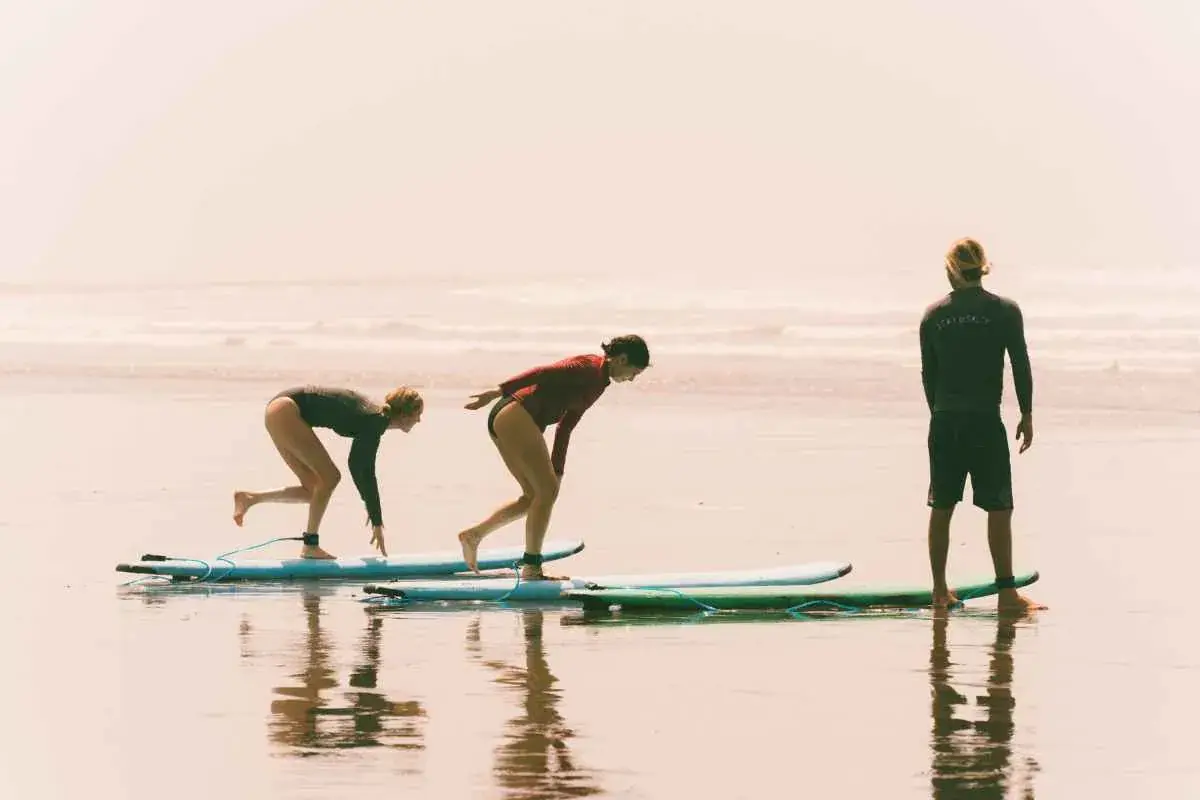
Professional training frameworks target these automatic reflexes through structured dry-land practice before students enter the water. By isolating complex physical actions into independent, trainable steps, coaches help students build clean muscle memory. This step-by-step approach prevents cognitive overload during the rapid transitions of wave riding.
The Hydrodynamic Lift Model
Understanding the physical relationship between a surfboard and moving water is essential for consistent wave acquisition. Board design dictates how weight must be distributed to maintain maximum forward speed:
-
Prone Trim Balance: Surfers must position their body weight perfectly along the centerline of the board to minimize paddling drag and maximize water flow.
-
Planer Surface Activation: When catching a wave, weight must shift forward to match the wave’s speed, allowing the board to glide on top of the water.
-
Rail Engagement Dynamics: To change direction, a surfer must apply pressure to the board’s edge, using the rail to cut into the wave face and maintain grip.
The Limits of Compressed Training Timelines
While high-quality coaching significantly speeds up early development, natural physical conditioning timelines cannot be bypassed in a one-week trip. Building the shoulder endurance required for long paddling sessions takes weeks of regular muscular stress.
Furthermore, learning to read the ocean is a visual skill that requires hours of observation under varying tide and wind conditions. Reputable operations acknowledge these physical realities, focusing on giving students self-guided practice habits rather than promising effortless mastery over a short stay.
Key Categories and Operational Structures of Wave Retreats
The domestic surf travel market features several distinct business configurations, each offering different combinations of price, safety supervision, and coaching depth.
Dedicated Progression Academies
These specialized operations function primarily as athletic training facilities, focusing on long-term skill development and ocean literacy. They feature structured weekly packages that combine lodging, targeted meals, video reviews, and land-based training tools.
Group sizes are kept small, allowing coaches to customize daily lesson plans to individual student needs. The primary trade-off is cost, as these specialized environments require a larger financial investment than standard day schools.
Luxury Adventure Resorts
Operating within premium coastal properties, these programs blend entry-level surf guiding with high-end hospitality amenities. Lessons are arranged around the guest’s preferred schedule, often utilizing private boats or off-road vehicles to access uncrowded wave zones.
While they offer excellent comfort and individual attention, the instruction can sometimes skew toward entertainment rather than rigorous technique. They are best suited for travelers who prioritize premium lodging alongside occasional water sports guidance.
High-Volume Recreational Camps
These large-scale businesses focus on high guest volume, utilizing shared housing and large group structures to keep prices accessible. They cater primarily to casual travelers and seasonal tourists seeking an introductory experience in the white water.
While useful for a basic introduction to the sport, these schools rarely offer detailed technical feedback, video reviews, or deep oceanography lectures. Their high guest turnover makes them unsuited for surfers looking for structured athletic advancement.
Surf Training Structural Typology Matrix
Strategic Decision Logic for Travelers
Selecting the correct retreat structure requires an honest assessment of your personal athletic goals, budget, and learning preferences. A developing surfer looking to transition from white water to unbroken green waves will likely find a high-volume recreational camp frustrating due to the lack of individual feedback.
Conversely, a casual vacationer may find the detailed video reviews and early morning schedules of a progression academy exhausting. Aligning your expectations with the camp’s underlying business model is key to a productive trip.
Detailed Real-World Training Scenarios and Field Audits
Scenario 1: Managing Crowded Beach Breaks
This field audit examines a progression academy operating near a highly populated sandbar break in Southern California during the peak summer season.
-
Context: The academy must conduct daily instructional sessions in a marine zone shared with recreational swimmers, local surfers, and other schools.
-
Analysis: High crowd density increases the risk of board collisions and limits the number of clear waves available to students during a session.
-
Operational Correction: The head coach shifts the daily schedule to match low-crowd hours, using early morning dawn patrols and mid-day tide changes. Instructors use bright, color-coded rash guards to maintain visual contact with their students in the lineup.
-
Result: Students practice wave selection in a controlled manner, avoiding crowded zones while learning line etiquette in a real-world setting.
Scenario 2: Transitioning to Unbroken Swells
This scenario profiles an intermediate surfer attending a Hawaiian training facility to transition from riding broken white water to catching green waves.
-
Context: The student possesses adequate paddling strength but struggles with timing, positioning, and wave selection in open blue water.
-
Analysis: The student’s primary failure mode is paddling directly at the incoming wave face, which causes them to miss the critical entry zone.
-
Operational Correction: The coach uses a two-step intervention. First, they conduct a land-based workshop using topographical maps to explain how swells move over the local reef. Second, in the water, the coach sits next to the student, using visual markers on the coast to guide their positioning.
-
Result: The student learns to spot the wave apex early, adjusting their paddle angle to match the wave shape and achieving independent entry into green waves.
Scenario 3: Correcting Deep Stance Flaws
This case study reviews a video analysis session at a Pacific Northwest training retreat focused on fixing long-term movement errors in an adult student.
-
Context: A surfer with three years of self-taught experience cannot execute basic turns because of an incorrect, wide stance.
-
Analysis: Reviewing afternoon video files shows the student’s back foot is positioned too far forward, locking their hips and preventing the fins from turning.
-
Operational Correction: The instructor moves the student to a land-based surf-skate simulator, drawing clear placement marks on the deck. The student practices dropping their back knee down and rotating their shoulders through simulated turns on smooth asphalt.
-
Result: The visual and physical feedback breaks the old stance habit, allowing the student to replicate the correct posture during the next morning’s ocean session.
Scenario 4: Navigating Unexpected Marine Hazards
This safety audit examines a retreat operating along the rugged Central California coast during an unexpected increase in winter swell size.
-
Context: Mid-way through a morning lesson, a distant storm causes wave heights to rise quickly, generating strong rip currents across the primary training zone.
-
Analysis: The changing ocean conditions exceed the paddling capabilities of the beginner group, creating a risk of students being swept out into deep water.
-
Operational Correction: The lead instructor executes an immediate evacuation plan. Using pre-arranged whistle signals, coaches gather students into a tight group and guide them into a shallow sandbar channel where the broken white water naturally pushes them back to shore.
-
Result: All guests return safely to the beach without panic, demonstrating the importance of formal safety protocols and local ocean knowledge.
Planning, Cost, and Resource Dynamics
Choosing among the top wave riding retreats america requires a clear understanding of the financial and logistical requirements involved. True instructional quality relies on specific operational expenses that cannot be maintained at rock-bottom prices.
Analyzing Back-End Business Costs
When comparing different programs, travelers must look past low package prices to evaluate the backend operational costs of high-quality coaching. Professional academies invest significantly in maintaining low student-to-instructor ratios, hiring certified watermen, and purchasing modern equipment fleets.
They also allocate funds for comprehensive liability insurance, regular safety training, high-speed camera systems, and reliable transport logistics. These necessary operational expenses are reflected in higher base prices but guarantee a safer, more professional learning environment.
The Hidden Trade-Offs of Budget Operations
Selecting a surf camp based solely on a low price often results in hidden compromises that slow down technical development. Low-cost operations typically cut corners by increasing group sizes, using worn-out foam boards, and hiring inexperienced, uncertified staff.
They may also save money by skipping video reviews, using public beach access points, and reducing safety oversight in the water. These cutbacks increase the risk of physical injury and often mean students leave without making real, measurable progress.
Financial Investment Tiers and Expected Outcomes
Technical Tools, Learning Strategies, and Support Systems
High-quality surf retreats distinguish themselves by using advanced tools to bridge the gap between what a student feels and actual wave performance. These technical systems help coaches diagnose errors and track progress accurately.
The Role of Scheduled Video Reviews
Video analysis is an invaluable tool for adult learners trying to master complex physical movements in a fluid environment. Because surfing happens quickly, students often have an inaccurate sense of their own body positioning while riding.
Reviewing high-frame-rate video allows coaches to pause and break down movements frame by frame during afternoon classroom sessions. Seeing alignment errors alongside examples of correct technique helps students make rapid, precise changes in the water.
Integrating Surf-Skates for Muscle Memory
Carving skateboards, specifically designed surf-skates with flexible front trucks, are highly effective for building muscle memory on solid ground. In the ocean, a beginner may spend only a few combined minutes actually riding waves during a two-hour session.
On land, a surf-skate allows for endless, controlled repetitions of turns, compressions, and upper-body extensions. This targeted repetition helps automate correct postures, making them much easier to replicate once back in the water.
The Limits of Technology in Surf Training
While technical training tools speed up progression, they have clear operational boundaries. Video analysis is only as useful as the coach’s ability to explain mechanics and provide actionable steps for improvement.
Too much technical feedback can also cause analysis paralysis, where a surfer becomes overly focused on form and struggles to adapt to changing ocean conditions. Dry-land simulators mimic turning postures but cannot replicate the paddling stamina and wave-reading skills required in the water.
Risk Landscape and Compounding Failure Modes
Substandard coaching introduces a range of physical and mental risks that can slow progression and compromise water safety. Understanding these failure modes helps students identify and avoid low-quality training habits.
Poor Technique Habit Formation
When instructors fail to correct basic movement errors early on, students quickly build flawed muscle memory that limits their progress. Common examples include a stiff stance, poor arm placement, and looking down during the pop-up transition.
These uncorrected errors make it difficult to progress to turning or speed generation, requiring significant effort to unlearn in later training phases.
Water Panic and Loss of Confidence
Pushing a student into waves that exceed their current skill or swim fitness level can trigger intense anxiety and water panic. Substandard coaches often misread student confidence, leading to scary experiences in heavy currents or deep water.
This psychological stress can cause a total loss of water confidence, prompting students to abandon the sport entirely due to preventable management errors.
Governance, Operational Maintenance, and Long-Term Adaptation
Top-tier surf camps protect their educational standards by using structured quality control systems and regular staff evaluations. These management processes separate professional training facilities from unorganized tourist schools.
Managing Instructor Pacing and Performance
Continuous time in the sun and moving water places a heavy physical demand on surf coaches over a long season. High-quality academies manage this workload by setting strict limits on daily coaching hours and organizing staff rotations.
This corporate care keeps instructors energized, focused, and ready to provide detailed, personalized feedback during every afternoon session.
Implementing a Tiered Progression Checklist
To ensure consistent training across different groups, professional camps use a standardized skill progression framework. This checklist defines clear technical benchmarks that a student must master before moving to more advanced wave types:
-
Level 1 Foundation: Clean prone paddling balance, effective board management through broken waves, and a smooth pop-up on flat water.
-
Level 2 Independence: Accurate wave selection timing, independent white-water riding, and basic steering control.
-
Level 3 Transition: Navigating out to the main lineup via channels, reading open swells, and executing angled takeoffs on unbroken green waves.
-
Level 4 Optimization: Generating speed along the wave face, clean rail engagement during turns, and safe exit strategies.
Measurement, Tracking, and Evaluation Frameworks
Measuring athletic growth in a fluid marine environment requires moving past general impressions to track clear, objective indicators of skill and safety awareness.
Process Inputs vs. Outcome Metrics
Professional coaches evaluate student progression by balancing direct process habits against final outcome numbers:
-
Process Habits (Inputs): Chest elevation while paddling, hand placement during the pop-up, eye focus on the wave face, and safe board management during falls. These habits show the student’s underlying form and safety discipline.
-
Outcome Numbers (Outputs): Total waves successfully caught per session, ride duration in seconds, and wave selection accuracy. These results reflect how well the underlying process habits are being executed under load.
Qualitative and Quantitative Assessment Balance
A complete evaluation system combines basic numerical data with qualitative analysis from video reviews. For instance, tracking your wave capture efficiency—waves caught versus waves attempted—alongside video clips of your stance stability provides a clear picture of growth. This empirical approach helps surfers spot specific performance plateaus and work with coaches to adjust their training focus.
Common Misconceptions and Oversimplifications
Myth 1: Great Surfers Make the Best Coaches
Many consumers assume that an individual with elite surfing skills will automatically make an exceptional instructor. In reality, the ability to execute high-performance maneuvers does not guarantee a capacity to teach foundational mechanics to a beginner. Effective coaching requires patience, structural communication, and an understanding of sports science—qualities that are independent of personal wave-riding talent.
Myth 2: Pushing Students into Waves Accelerates Development
A common practice at tourist schools is having instructors stand in shallow water to physically push students into waves. While this helps guests stand up quickly, it bypasses the critical skills of paddling, timing, and wave selection. This shortcut creates a dependency habit, leaving the student unable to catch waves without assistance once the camp ends.
Myth 3: Formal Certifications Are Just Unnecessary Bureaucracy
Some travelers assume that practical experience in the ocean matters more than formal coaching certifications like those from the ISA. While ocean familiarity is essential, formal training ensures an instructor understands modern water safety, rescue techniques, and adult learning models. Certified coaches follow standard guidelines that protect student safety and support structured skill development.
Ethical, Practical, and Environmental Considerations
Operating a professional surf retreat requires a deep commitment to environmental stewardship and respectful community integration. The rising popularity of surf tourism places significant stress on delicate coastal ecosystems and local communities.
Preserving Delicate Marine Ecosystems
Elite training academies take a proactive role in minimizing their environmental footprint and protecting local marine life. Operations reduce plastic waste, use reef-safe sunscreens, and organize regular beach cleanups with their guests.
By teaching students to respect local wildlife, dunes, and water quality, these businesses help preserve coastal environments for future generations of surfers.
Respecting Local Lineup Dynamics
Introducing large groups of traveling surfers into established local lineups can create tension with resident wave riders. Responsible retreats manage this dynamic by teaching strict water etiquette, safety rules, and respect for local custom.
Instructors guide students to less crowded peaks, ensuring their groups do not dominate a single zone or disrupt the local community. This respectful approach builds positive relationships between travelers and local resident surfers.
Synthesis and Strategic Judgment
Selecting among the top wave riding retreats america is ultimately an exercise in aligning your personal athletic goals with an operation’s training philosophy. True progress in the ocean cannot be bought through luxury amenities or bypassed using quick shortcuts like push-in coaching.
It requires a systematic commitment to learning wave mechanics, building physical conditioning, and practicing safe water habits under professional guidance.
By looking past lifestyle marketing to audit staff certifications, student-to-instructor ratios, and video diagnostic tools, travelers can identify high-quality training environments. Investing in a professional, metrics-driven academy protects your safety, maximizes your financial resources, and builds a solid foundation for independent wave riding.